Jane Austen has surprisingly established herself over the years as one of my favourite authors and I have to admit my presence among the hardcore Pride & Prejudice and Mr Darcy devotees of which there are many in world. Knowing very well her "three big ones", Pride & Prejudice of course, Emma and Sense and Sensibility, I have recently decided to catch up with her other novels and bought Northanger Abbey and Mansfield Park.
Northanger Abbey, published in 1817, is the story of young Catherine Morland who is a passionate reader of mystery novels, the more bloodspilling the better. She is sent to accompany Mr and Mrs Allen to Bath for some weeks and meets Isabelle and John Thorpe of which the former becomes her new best friend.
When she also gets close to the Tilney siblings, of which Henry becomes her love interest, the Thorpes start clinging to her. Indeed, as the Thorpes mistake Catherine for the heiress of the Allens’ fortune, they plan to make double marriage to Catherine and her brother. While Catherine refuses John, Isabella succeeds in getting engaged to James Morland. Catherine subsequently accepts Eleanor Tilney’s invitation to their mansion Northanger Abbey, where her imagination goes wild and she imagines that General Tilney killed his wife.
As in the meantime Isabella discovers the truth of their lack of wealth, she dissolves her engagement and tries to catch Henry’s brother Frederick Tilney instead. Thereby, General Tilney who had been mislead about the Morland’s wealth as well, more or less throws Catherine out and it is Henry who closes the story with a happy ending.
Catherine is a young, naïve but somewhat foolish girl, as her love for gothic romance and unbound imagination lead her first to wish for some mystery and horror in her own life and to imagine it herself and take it for reality later on. I did not feel very much with her, she is entertaining at most, often charming in her stupidity but overall not interesting beyond that.
Even though Henry presents some similarities with Darcy, the wit and sarcasm and the quality of being a good brother to his sister Eleanor, Catherine is no Elizabeth. Indeed, she barely understands what he is talking about in their long discussions and thinks he is utterly charming and intelligent from the first moment. That Henry ends up marrying her is based on his preference not for an equally intelligent partner, but a refreshingly naïve girl. I liked him in general but maybe he disappointed me somewhat as I thought at the end, “here goes a future Mr Bennett” even if that may be unfair to Catherine, who is by no means as insufferable as Mrs Bennett.
I watched the BBC movie two years or so ago but fortunately I did not remember exactly the details of the storyline anymore so that I could discover the novel on its own. I found Northanger Abbey a rather short read compared to the novels I previously read but not less entertaining. It is a surprising read, as Austen ventures into open parody and chooses as a target the gothic romance novel. Basically, if Austen was writing this today, she would turn Catherine into an even weaker Bella (is that actually possible?) and make fun of Twilight.
Jane Austen: "Northanger Abbey"
Musing Mondays 10/08/09
 Yesterday, Musing Mondays came up with this question:
Do you have a favourite publishing house -- one that puts out books that you constantly find yourself wanting to read? If so, who? And, what books have they published that you've loved?
Like most people I know, I do not have any favourite publishing house, I am in fact simply considering the whole range of book genres that interest me when deciding what to read next. However, I often pick up the little catalogues publishers use to print in Germany to see their new books and the other ones with small introductions. The format is nice and handy and I always find something intriguing that I will eventually read. Now that I try to answer this question, I effectively become aware that I tend to pick up the same publisher catalogues all the time, limiting my choice on 2-3 of them. Indeed, I always take the dtv catalogue (Deutscher Taschenbuchverlag, German paperback publishing house) which has an extremely broad range of books from classics to new publications of quality, the Oetinger catalogue more of for the child inside me than any buying interest (they are the one big children fiction publishing house in Germany and were the first to publish Pippi Longstocking outside of Sweden) and the Diogenes catalogue.
Comments section fixed
It took some days for me even to figure out that it was impossible to comment on this new layout! But now it should be fixed and I even have the "posted by" back at the bottom I was looking for. When I will find some motivation again to look at the template code again, I will try to get the date header a bit down, there's too much space between it and the post title.
Friday Fill-In #136

1. Litchee juice is my favorite summertime drink.
2. My favorite John Hughes movies is The Breakfast Club.
3. Shark skin is something I love to touch.
4. The full moon is the perfect moment to go out and have a midnight walk.
5. I want to crawl back into my bed right now.
6. When daylight fades, the sky is tainted in thousand colors.
7. And as for the weekend, tonight I'm looking forward to enjoy my early goodbye-dinner with my work colleagues, tomorrow my plans include visiting Bulgakov's flatmuseum and Sunday, I want to see the Palace of the Romanov Boyars that I couldn't go to last weekend!
What to (not) do with a book
Today's news are filled with trial reports about people who get indemnities because they put their cat into the microwave or drink burning coffee and no proper instructions told them not to.
So just in case, take notes.

Terry Pratchett: "Equal Rites"
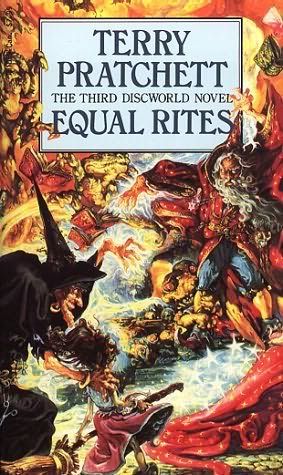
The story goes as follows: Drum Billet, a wizard, ends up in Bad Ass, a small village up the mountains to give on his magical staff to the 8th son of an 8th son. As the child is born, Drum Billet dies without knowing that the newborn is not a son, but a daughter, who per definition can never be a wizard.
However, Esk, as the girl is called, develops extensive magical powers and is taken in to be trained by the with Granny Weatherwax. As this is not enough for the long term, Granny Weatherway and Esk travel to the Unseen University, a hotspot for wizards.
At first, Esk is refused, because she is a woman, but after a lot of troublemaking in which her wizard friend accidentally lets in creatures from the dungeon dimensions, the university is flooded and the head of the institution is more or less saved by Granny Weatherwax on the way to get the magical staff back - hey, it's Discworld! - a happy end finishes the book not à la "and they had many children" but as in "they continued to research the power of how to not use magic".
Discworld novels are always an enjoyable read, some are simply genius, some are just plain funny. Equal Rites is not part of the best ones, but does not fail on its themes and even surprises by its conclusion on magic: that the greatest power comes when you refuse to use any other power. The great character Granny Weatherwax is introduced, who fortunately will pop up in the following novels from time to time and who maybe adds the most fun to the story. The other characters are not developed as much and even Esk just seems to serve the purpose of one story. Indeed, the story ends while she is still a teenager and so we do not get to know what kind of wizard she will be.
Overall, a funny and quick read with some great points that could have been developed further, but we feel that this is still the beginning of Discworld.
Musing Mondays 03/08/09
1) If you don't frequent your local library, why not?
At the moment, I am abroad in Russia and as I do not speak Russian well enough to read novels, I did no see the need to look for a local library.
2) If you do visit the library, how often do you go?
When I am in my city, I try to go every week. My "local library" is actually half an hour bus drive away so when I am very busy I cannot make it so often.
3) Do you have a favorite section that you always head to first, or do you just randomly peruse the shelves?
I usually check out the shelf with the new books first and the ones that have been freshly returned. Then I go through the shelves of fiction and spend most of my time there.
4) How many books are you allowed to check out at one time? Do you take advantage of this?
I am allowed 10 I believe and usually there are around 8 in my bag when I am leaving the library.
5) How long are you allowed to have the books checked out?
4 weeks.
6) How many times are you allowed to renew your check-outs, if at all?
2 times I believe.
7) What do you love best about your particular library?
It is never crowded when I come (usually on Friday afternoons), there is a very nice childrens' section on the whole upper floor. It's simplicity of a honest small city library that is also hosting children events esp. around Christmas reminds me of the library I went to as a kid.
8) What is one thing you wish your library did differently?
I wish they had more space for more fiction, one half a floor is really not enough, even if I am far from having read all their books. I also think they should stock up on classics, some authors really should be there with their whole work.
9) Do you request your books via an online catalogue, or through the librarian at your branch?
I usually do not request books as I am never sure if I will be able to go there on the day I have to pick up the book. But I use the online catalogue to make my pre-choices beforehand.
10) Have you ever chosen a book on impulse (from the online catalogue OR the shelves) and had it turn out to be totally amazing? If so, what book was it, and why did you love it?
Taking books on impulse happens really often, esp. when it is a library and not a bookshop. I remember how I took once A Wild Yearning (at least I think that was the title) by Penelope Williamson, a genre I am not usually reading and I really enjoyed it. Afterwards I read two of her other books and they were a disappointment as typically in the cheap romance genre I am not into.


