 I read "A Company of Swans" in December 2009 together with "A Countess Below Stairs" by the same authors, when I just needed some not-too-stupid chicklit, basically comfort reads. Back from the library, I immediately sat down in my armchair and read bot.
"A Company of Swans" seemed to be the more elaborate of the two, as it not only gave insights to ballet, but also brought the reader to the Amazon in a rather believable way.
Harriet Morton is the shy daughter of an intolerant and controlling professor, who wants to marry her off to his assistant. Ballet being her only joy in life, her life changes all over when she is chosen by a visiting ballet master to accompagny his ensemble to the Amazon. Running away from her father, who later sends her fiancé in a quite burlesque search of her, she reaches the Amazon and meets the attractive Rom Verney. Very quickly, she suspects him to be a member of the very wealthy family in her hometown, of which the head just died. Throughout the whole novel, Rom and she have multiple misunderstandings, the more as they become lovers. For example, she believes that Rom is still in love with his former fiancée while Rom thinks she won't quit ballet for him (and actually despises his former fiancée).
Anyway, it's chicklit, but actually quite good one, as the setting and the background topic (ballet) and some great characters like the star ballerina and the ballet master - a very cute couple in their old days - make it more than just a love story. I also liked the comedic moments in it, especially when Harriet has to replace her friend for a job and jumps out of a cake to dance in a gentlemens' club, where her fiancé Edward turned out to be.
Eva Ibbotson: "A Company of Swans"
Hooray me! Hooray Anna Karenina!
Just to announce my immense satisfaction and relief: I have finished Anna Karenina!
Yes, I loved it but no, it was not easy to read. Not because of the style, which was extremely good and very funny at moments but because of the content and Tolstoi's tendency to stress details, especially anything about: agriculture, spirituality, agriculture, the process of thinking without actually getting into the content of the character's thoughts (whoa, the last chapters on Lewin were pure hell), agriculture, Russia's society, the conditions of peasants, and did I mention agriculture?
It is a long, long book and at many times I just thought: "Please give this author a good editor!" but no, Tolstoi's work wouldn't be as a literary monument as it is without his overwhelmingly rich prose. Many parts seem not necessary because the story is supposed to be about the tragedy of Anna Karenina and they shift the focus towards Lewin (who apparently is an embodiment of Tolstoi himself) and theories on farming and society. I still could not decide if the title was well chosen or a failure, the character Anna Karenina is not structuring the book enough to justify it. In fact, Lewin's parts are so prominent and his connection to Anna Karenina so few and even if I understand that he is her counterpart, why is her name the title?
Reading Tolstoi is like going through a mill but it is worth it. 5 stars. But I am not going to reread it anytime soon, nor will I read any other Tolstoi for the next 2 months.
Jane Austen: "Northanger Abbey"
Jane Austen has surprisingly established herself over the years as one of my favourite authors and I have to admit my presence among the hardcore Pride & Prejudice and Mr Darcy devotees of which there are many in world. Knowing very well her "three big ones", Pride & Prejudice of course, Emma and Sense and Sensibility, I have recently decided to catch up with her other novels and bought Northanger Abbey and Mansfield Park.
Northanger Abbey, published in 1817, is the story of young Catherine Morland who is a passionate reader of mystery novels, the more bloodspilling the better. She is sent to accompany Mr and Mrs Allen to Bath for some weeks and meets Isabelle and John Thorpe of which the former becomes her new best friend.
When she also gets close to the Tilney siblings, of which Henry becomes her love interest, the Thorpes start clinging to her. Indeed, as the Thorpes mistake Catherine for the heiress of the Allens’ fortune, they plan to make double marriage to Catherine and her brother. While Catherine refuses John, Isabella succeeds in getting engaged to James Morland. Catherine subsequently accepts Eleanor Tilney’s invitation to their mansion Northanger Abbey, where her imagination goes wild and she imagines that General Tilney killed his wife.
As in the meantime Isabella discovers the truth of their lack of wealth, she dissolves her engagement and tries to catch Henry’s brother Frederick Tilney instead. Thereby, General Tilney who had been mislead about the Morland’s wealth as well, more or less throws Catherine out and it is Henry who closes the story with a happy ending.
Catherine is a young, naïve but somewhat foolish girl, as her love for gothic romance and unbound imagination lead her first to wish for some mystery and horror in her own life and to imagine it herself and take it for reality later on. I did not feel very much with her, she is entertaining at most, often charming in her stupidity but overall not interesting beyond that.
Even though Henry presents some similarities with Darcy, the wit and sarcasm and the quality of being a good brother to his sister Eleanor, Catherine is no Elizabeth. Indeed, she barely understands what he is talking about in their long discussions and thinks he is utterly charming and intelligent from the first moment. That Henry ends up marrying her is based on his preference not for an equally intelligent partner, but a refreshingly naïve girl. I liked him in general but maybe he disappointed me somewhat as I thought at the end, “here goes a future Mr Bennett” even if that may be unfair to Catherine, who is by no means as insufferable as Mrs Bennett.
I watched the BBC movie two years or so ago but fortunately I did not remember exactly the details of the storyline anymore so that I could discover the novel on its own. I found Northanger Abbey a rather short read compared to the novels I previously read but not less entertaining. It is a surprising read, as Austen ventures into open parody and chooses as a target the gothic romance novel. Basically, if Austen was writing this today, she would turn Catherine into an even weaker Bella (is that actually possible?) and make fun of Twilight.
Terry Pratchett: "Equal Rites"
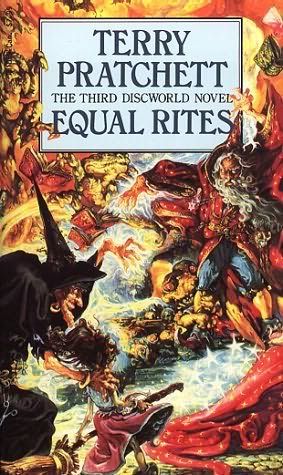 Equal Rites is the third fantasy novel of Terry Pratchett's Discworld series and was recommended to me by my former professor of Icelandic folklore. Published in 1987, it explores the themes of female magic vs male magic, gender equality, institutionalised vs grassroot magic and the use of power.
The story goes as follows: Drum Billet, a wizard, ends up in Bad Ass, a small village up the mountains to give on his magical staff to the 8th son of an 8th son. As the child is born, Drum Billet dies without knowing that the newborn is not a son, but a daughter, who per definition can never be a wizard.
However, Esk, as the girl is called, develops extensive magical powers and is taken in to be trained by the with Granny Weatherwax. As this is not enough for the long term, Granny Weatherway and Esk travel to the Unseen University, a hotspot for wizards.
At first, Esk is refused, because she is a woman, but after a lot of troublemaking in which her wizard friend accidentally lets in creatures from the dungeon dimensions, the university is flooded and the head of the institution is more or less saved by Granny Weatherwax on the way to get the magical staff back - hey, it's Discworld! - a happy end finishes the book not à la "and they had many children" but as in "they continued to research the power of how to not use magic".
Discworld novels are always an enjoyable read, some are simply genius, some are just plain funny. Equal Rites is not part of the best ones, but does not fail on its themes and even surprises by its conclusion on magic: that the greatest power comes when you refuse to use any other power. The great character Granny Weatherwax is introduced, who fortunately will pop up in the following novels from time to time and who maybe adds the most fun to the story. The other characters are not developed as much and even Esk just seems to serve the purpose of one story. Indeed, the story ends while she is still a teenager and so we do not get to know what kind of wizard she will be.
Overall, a funny and quick read with some great points that could have been developed further, but we feel that this is still the beginning of Discworld.
Jeffrey Eugenides: "Middlesex"
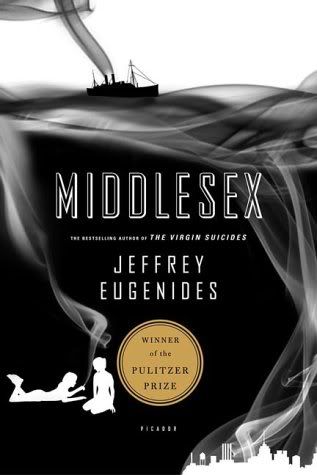 I have wanted to read this Pulitzer-winning Middlesex for at least a year, not only because I had read and liked reading The Virgin Suicides maybe 3 years ago but because the story seemed fantastic. I have always been very fond of marginal people, different lives and I felt that this novel was about a literature-shaping character.
In the end, the story turned out to be even better than "just" the life of a hermaphrodite so that I closed this book knowing that it had made its way into my list of favourites. Middlesex is about Calliope, a child that grows up as a girl and discovers she's a boy in her teens - that is the very basic storyline. But as Calliope herself does not retell her life until the reader has got maybe 60% into the book, the story reveals itself as the story of her Greek family that traces back its origins to a small village in today's Turkey, where their fate is sealed.
Reading along the line of the adventurous migration of the grandparents who flee Smyrna during the Greek-Turkish war to the lovestory of the parents is also reading about Greece and Turkey, about Greeks in America, about America's economical boom, about Ford and immigrants' neighbourhoods in Detroit, about the prohibition and Canada, about self-made-men and recession, about the sixties, about the seventies. About family dynamics.
And about growing up also, as Calliope struggles through puberty. As it is a life changing development that we experience all, one can relate to Calliope so far and feels with her when she gets further into questions that we have been lucky enough not to face. Being a hermaphrodite is less difficult as becoming one and Calliope has to leave her family and her love in order to find Cal, the man who is a good daughter to his mother.
Overall, I immensely enjoyed reading this novel. Eugenides has a fantastic way of telling this story, of using the Greek mythology to soften its corners and leave the readers with a real masterpiece.
L. M. Alcott: "Good Wives"
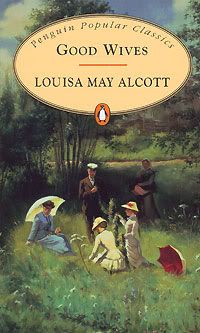 This sequel of the wonderful Little Women has been laying around for at least a year and it is in the middle of many challenges to finish that I pick it up to read it.
The little women are now three years older, Meg is getting married, gives birth to twins very soon and is learning to become the perfect little housewife she is meant to be. Beth stays the quietest of the family members and slowly drifts towards her death. Amy's ambitions of succeeding in the great society and marrying for wealth change as she falls in love with Laurie, whom she ends up marrying. And Jo, my funny beloved Jo, writes alot but basically gives it up in the end, gets more and more boring, has no interest in men until she meets the much older Bhaer and spoils what could have been one of the best love stories in literature by refusing Laurie.
I liked this novel a great deal because of Alcott's very good writing, because it allows me to stay a little longer with the little women and draws quite a few interesting storylines at the beginning. Meg's domestic difficulties to manage both her role as a mother and as a wife to John for example could have been an actual theme in the book, were their appearance and their resolution in a happy ending not condensed in a single chapter. Beth does not take part in the story anymore except when she dies and as much as I agree that she has ever been a quiet and invisible girl, I feel she has been left out here.
I never had much liking for Amy, but Good Wives made her more interesting. Her ambitions both in drawing (and her eagerness to see the limits of her own talent) and society in the context of her deep feelings for her family and background were the foundation of a rich character. Her scenes with Laurie, even if the second part of the books changed him and made him hard to believe, were excellent in developing her character. However, as soon as their marriage is settled, she disappears as a good little wife behing him and does barely utter a word anymore until the end. Disappointing.
I still don't know if Jo's fate pleases me or not. Of course I would have loved her to say yes to Laurie in the end, keeping of course the dramatic first proposal and rejection as a twist. The very basic facts however, that she meets Bhaer, falls in love with that antihero and builds a school for boys, fit her character and interesting adds to her personality. But that her humor disappears along the chapters as well as her character, that she tries to become a second Beth and stops writing - that is not showing how someone is growing up and becoming a woman, that is spoiling and killing off the leading force of Little Women.
Robert Tallant: "The Voodoo Queen"
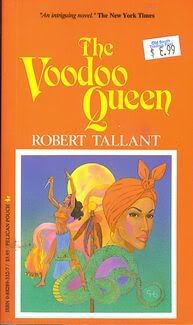 I bought this novel on my trip to New Orleans in March 2009 in the Voodoo Spiritual Temple along with Robert Tallant's other work Voodoo in New Orleans, a collection of accounts of Voodoo practices and believers.
Here's the text on the back of the book:
"Witch? Sorceress? Daughter of Satan? Murderer? Thief? Saint? Which label best fits Marie Laveau? Queen of the Voodoos, she is considered to have been the most important voodooienne ever to have reigned on this continent. Robert Tallant, attempted to make use of all available facts and information in re-creating the life of this famous woman. Marie Laveau, the last and most stories American Sorceress, continues to weave her spell as those who read this fascinating portrait will discover."
The novel is a fictionalized biography of the mysterious Marie Laveau, an attempt to explain what her life could have been starting from the little known pieces. She was a Voodoo queen, she was a hairdresser, she got married once and gave birth to many children, she got a house for helping a rich man's son to win his trial, she fed prisoners close to hanging, she was called a good Catholic and famous for her gris-gris.
As I read Tallant's Voodoo in New Orleans beforehand, I knew how what Tallant considered the basic elements of Marie Laveau's characters, using her appearances in newspapers to structure her life. In the novel, we start with a young Marie who gets married to her soulmate. But her few contacts with Voodoo priestesses estrange her skeptic husband from her and she finally looses him to the sea. To make a living, she works as a hairdresser - a position which will be very useful to her later, as it gives her insight into society gossip (and therefore power over potential clients) and control over the slave grapevine. Slowly, she becomes a known and feared figure within the Voodoos and reaches the status of queen.
The whole novel shows her struggle to manage her family, do her work (Voodoo) and keep her position against several rivals, make a living and salve her conscience when her Catholicism puts her in front of a dilemma. At some moments, Marie can seem selfish, because she does not behave very motherly towards her children and does not know them all too well. But the more one gets into the story, the more becomes clear, that Marie Laveau is simply a business woman of her time. Her attempts of managing and succeeding in every aspect in her life are rarely that successful, as she either looses her clients, her followers or her family. Her love life is a compromise after the loss of her husband, as she only slowly agrees to allow Glapion in her life. In her last years, she refuses that her male best friend and companion becomes more to her and finishes her life as the solitary woman she had always been, despite her many children and acquaintances.
I liked this novel very much because I did not take it as a biography - for that, there was too much speculation and pure fiction. But Tallant's work is a nice attempt to draw Marie Laveau's personality and I see her with different eyes now that I have read how she could have maybe lived. Beyond that, this novel is of great value to any New Orleans-lover as it depicts the exciting city at its peak of a melting pot of Spaniards, Creoles, French/Cajuns, Americans, free Blacks and slaves.
Steinunn Sigurðardóttir : Le Cheval Soleil
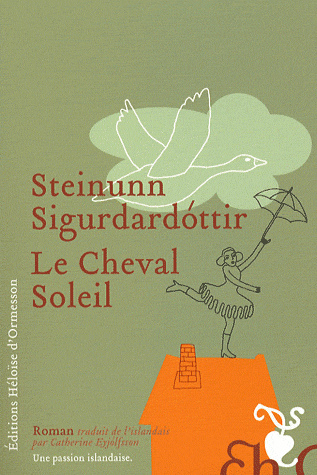 Title: Sólskinshestur (Icelandic), Le Cheval Soleil (FR), Sonnenscheinpferd (DE), in English that would be Sunshinehorse, but it hasn't been translated yet.
Steinunn Sigurðardóttir, is an Icelandic novelist and poet. I got this French translation from my Grandmother for last Christmas and did not read it until now. These last days I needed a book to fill the gap until the start of the Southern Reading Challenge, for which The Sound and the Fury by Faulkner is waiting, so I finished Sólskinshestur (for no challenge at all).
For a brief summary, I would just say that the story evolves around Lí's childhood and adulthood as the daughter of absent-minded parents. She is somehow brought up by her German housemaid, who leaves early and then by Nellí, a poor alcoholic single mother whose own daughter has been taken away. Lí blossoms out like a flower when she experienced her first love, but she ends the relationship to mourn it for the rest of her life. After an unsuccessful marriage that brings her to Copenhagen for some years, she leaves her husband and two daughters to come back to Iceland.
This book was very different from what I expected, maybe because I did not know that Steinunn was also a poet. The writing is very poetic and from time to time, parts of the story are presented in poems, about which is unclear whether they are Lí's thoughts (as she is usually the narrator of the story) or an unknown voice. Even if this poetic writing sometimes made a distance between the reader and the story, I was captured by Lí's life and the sad characters around her.
I loved her adorable brother Mummi and was intrigued by her cold mother Ragnhild, whose job as a doctor and the children dying under her hands have torn her apart on the inside and made her incapable of showing love and attention to her children. Haraldur is a father who tries to escape having the same behaviour as Ragnhild, but generally fails.
The character of Lí is broken by two things. First, the suicide of Nellí she discovered and never accepted as the truth (she invented that Nellí went working in the countryside) until she finds Nellí's daughter to tell her the story to realize it at last. Then, the loss of the love of her life, who brings the story's climax as he suddenly comes back to Iceland and makes of the past a possible future.
Steinunn herself called this novel her saddest story and it is true that I closed the book deeply moved by the broken lives it contained.
Joy Kogawa: "Obasan"
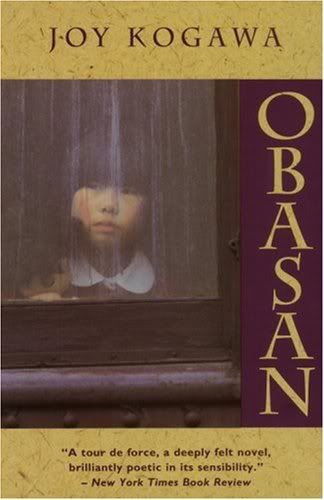 Obasan is one of the books I had to read for the course "Canadian Literature & Multiculturalism" and deals with Canadian citizens of Japanese origin who are interned as public enemies during WW2. This highly autobiographical novel is stunning in its quietness. In fact, we encounter the injustice and horrors only through the timid eyes of Naomi, the little girl of the family, and through the outspoken and "adult" letters Aunt Emily (who actually manages to escape the camps) writes to her sister.
This story shows the vulnerability of children of immigrants, how citizenship and the thereby aquired rights do not matter anymore when the country of origin is declared war on. Third generation of immigrants, who call themselves Canadians by their culture and affiliation, have been ripped of their rights not so long ago in a country that adorns itself with the supposed successes of multiculturalism.
This book tells the story of those many people and is well worth a read, even if not everyone will like the style of writing or the constant switching between different spaces of time.


